dailycharacter
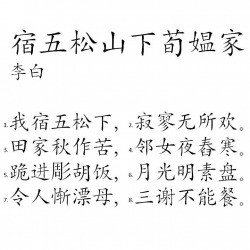
宿五松山下荀媪家 (李白)
Title: Overnight at Old Lady Xun's at the Foot of Five Pine Mountain ▪ 宿五松山下荀媪家
Author: Li Bai ▪ 李白
Poetic Form: lǜshī ▪ 律诗
Apologies, individual character links no longer available for this poem...
1. 我 + 宿 + ((五 + 松) + 下)
I + to spend the night + ((five + pine) + below)
gloss: I spent the night at the foot of Five Pine
(Mountain)
2. (寂 + 廖) + (无 + 所 + 欢)
(lonesome + empty) + (no + place + jubilant)
gloss: [I am] all alone, with no feeling of joy
3. (田 + 家) + (秋 + 作 + 苦)
(field + house) + (autumn + to regard as + bitter)
gloss: The Autumn is bitter for peasants
4. (邻 + 女) + 夜 + 舂 + 寒
(neighbor + woman) + night + to pound rice +
cold
gloss: The neighbor lady pounds rice in the
night; it is cold
5. (跪 + 进) + (彫 + (胡 + 饭))
(to kneel + to advance) + (to decorate + (wild +
rice))
gloss: [She] kneels down to proffer wild rice
6. ((月 + 光) + 明) + (素 + 盘)
((moon + light) + bright) + (plain + plate)
gloss: In the moonlight, the plate is plain/empty
7. (令 + 人) + 惭 + (漂 + 母)
(to create + person) + ashamed + (beautiful +
mother)
gloss: This makes a person ashamed [before]
the 'Beautiful Mother' (an old woman who gave
the historic personage Han Xin a meal in a time
of need)
8. (三 + 谢) + (不i + 能 + 餐)
(three + thanks) + (not + can + to eat)
gloss: I thank her three times and still cannot eat
(because I feel I do not deserve the food)
Author: Li Bai ▪ 李白
Poetic Form: lǜshī ▪ 律诗
Apologies, individual character links no longer available for this poem...
1. 我 + 宿 + ((五 + 松) + 下)
I + to spend the night + ((five + pine) + below)
gloss: I spent the night at the foot of Five Pine
(Mountain)
2. (寂 + 廖) + (无 + 所 + 欢)
(lonesome + empty) + (no + place + jubilant)
gloss: [I am] all alone, with no feeling of joy
3. (田 + 家) + (秋 + 作 + 苦)
(field + house) + (autumn + to regard as + bitter)
gloss: The Autumn is bitter for peasants
4. (邻 + 女) + 夜 + 舂 + 寒
(neighbor + woman) + night + to pound rice +
cold
gloss: The neighbor lady pounds rice in the
night; it is cold
5. (跪 + 进) + (彫 + (胡 + 饭))
(to kneel + to advance) + (to decorate + (wild +
rice))
gloss: [She] kneels down to proffer wild rice
6. ((月 + 光) + 明) + (素 + 盘)
((moon + light) + bright) + (plain + plate)
gloss: In the moonlight, the plate is plain/empty
7. (令 + 人) + 惭 + (漂 + 母)
(to create + person) + ashamed + (beautiful +
mother)
gloss: This makes a person ashamed [before]
the 'Beautiful Mother' (an old woman who gave
the historic personage Han Xin a meal in a time
of need)
8. (三 + 谢) + (不i + 能 + 餐)
(three + thanks) + (not + can + to eat)
gloss: I thank her three times and still cannot eat
(because I feel I do not deserve the food)
Translation
Overnight at Old Lady Xun's at the Foot of Five Pine Mountain
translation by Jessica Alexander ©
I overnight in the shadow of Five Pines, desolate and
cheerless.
Autumn is bitter to peasants;
The neighbor woman pounds rice late in the cold night.
Kneels, offers me wild rice, moonlight glinting off the
simple plate.
Beautiful Mother's generous hand humbles;
My meager thanks unfit for the feast.
translation by Jessica Alexander ©
I overnight in the shadow of Five Pines, desolate and
cheerless.
Autumn is bitter to peasants;
The neighbor woman pounds rice late in the cold night.
Kneels, offers me wild rice, moonlight glinting off the
simple plate.
Beautiful Mother's generous hand humbles;
My meager thanks unfit for the feast.
Analysis
Other Translations
Unable to find any current translations. Please contact me if you know of one!
